Incidental Take Permits for Coho Salmon
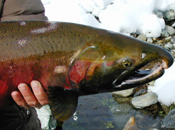
Following status reviews by the National Marine Fisheries Service (Weitkamp et al., 1995) and the California Department of Fish and Game (CDFG, 2002), coho salmon (Oncorhynchus kisutch) were listed as threatened in northwestern California and southern Oregon under both the federal Endangered Species Act (ESA) and California Endangered Species Act (CESA).
An Incidental Take Permit (ITP) is required by the ESA and CESA by any party planning to engage in any land or water use that might cause harm to listed species. Two different ITPs have been considered in the Klamath Basin. The first is for PacifiCorp's Klamath Hydroelectric Project, the second is for agricultural operations in the Shasta and Scott Valleys.
Proposed: ITP for PacifiCorp's Klamath Hydroelectric Project - Coho Salmon
PacifiCorp has applied to National Marine Fisheries Service (NMFS) for an ITP to cover the operation of the Klamath Hydroelectric Project. PacifiCorp (2011) proposed a related Habitat Conservation Plan (HCP) that includes conservation measures such as turbine venting at Iron Gate Dam to increase dissolved oxygen, increased flow variability to reduce disease-causing organisms, increased large woody debris below Iron Gate Dam, and the establishment of funds to pay for fish disease research and coho enhancement. NMFS (2011) released a draft Environmental Assessment of the ITP in May 2011, concluding that the HCP would have beneficial effects during the 10-period covered by the plan.
Halted: ITPs for Shasta and Scott River Agriculture - Coho Salmon
Coho salmon populations in both the Shasta and Scott River basins are at high risk of extinction (NRC, 2004). From 2006-2011, CDFG pursued a Shasta and Scott River Watershed-Wide Coho Salmon Incidental Take Permitting Program. In responses to a lawsuit filed by Klamath Riverkeeper, the program was halted on May 16, 2011 by a judge's order. In his ruling, the judge found that CDFG failed to fully mitigate the take of coho and failed to ensure that its program would not jeopardize the continued existence of coho."
Water temperature modeling performed during Total Maximum Daily Load (TMDL) studies for the Shasta (NCRWQCB 2006) and Scott (NCRWQCB 2005) indicate that water temperature cannot be adequately improved unless agricultural water diversion and ground water pumping is reduced; however, the proposed ITPs did not adequately address flow issues.
Shasta ITP Consortium Comments:
Quartz Valley Indian Community. 2006. Scoping Comments on Shasta River Basin Agricultural Coho Salmon Incidental Take Permit. Submitted to CDFG, Region 1 by QVIR. ITP filed with CDFG. 20 p
Quartz Valley Indian Community. 2008. Comments on Draft Shasta River Basin Agricultural Coho Salmon Incidental Take Permit. Submitted to CDFG, Region 1 by QVIR. ITP filed with CDFG. 13 p.
Scott ITP Work Group Comments:
Quartz Valley Indian Community. 2006. Scoping Comments on Scott River Basin Agricultural Coho Salmon Incidental Take Permit. Submitted to CDFG, Region 1 by QVIR. ITP filed with CDFG. 23 p
Quartz Valley Indian Community. 2008. Comments on Draft Scott River Basin Agricultural Coho Salmon Incidental Take Permit. Submitted to CDFG, Region 1 by QVIR. ITP filed with CDFG. 29 p.
Download Final Shasta and Scott ITP FEIR’s (very large! 35 Mb)
Final Scott River ITP Volume #1
Final Scott River ITP Volume #2
Final Shasta River ITP Volume #1
Final Shasta River ITP Volume #2
Summary of Issues - Shasta River Coho Salmon Incidental Take Permit (ITP) DEIR
- California Department of Fish and Game (CDFG) should not issue an Incidental Take Permit (ITP) for Shasta River coho salmon because the actions under the permit are not sufficient to recover the species.
- The Draft Environmental Impact Report (DEIR) rejects Dwinnell Dam removal option when its operation is illegal under CDFG Code 5937 and removal is critical to coho salmon recovery and water pollution abatement.
- DEIR failure to address needs of steelhead and Chinook salmon in the DEIR and ITP implementation impacts fails California Environmental Quality Act (CEQA) requirements for analysis of cumulative effects.
- DEIR ignores epidemic problem in the Shasta River basin of non-enforcement of laws related to stream flow and water allocation by CDFG, State Water Resources Control Board (SWRCB) Water Rights Division (WRD) and the Department of Water Resources (DWR).
- The ITP will not restore flows to streams that have been dried up illegally, reduce over-extraction of groundwater or increase flows in the lower Shasta River canyon to meet legal requirements and biological needs; therefore, coho will not be recovered.
- Lack of improvement of flows in the Shasta River and its tributaries means that recognized water temperature problems will not be resolved, and abatement of temperature pollution is critical to coho recovery.
- CEQA requirements compel CDFG to share all data from the existing DEIR and the Department needs to commit itself and the Shasta Valley RCD to full disclosure and public sharing of all data, including raw data.
- Decades of increasingly intensive agricultural activities in the Shasta River, including flow reductions, have caused increasing levels of “take” of coho salmon to the point that the species is at high risk of extinction, also known as Jeopardy under the California Endangered Species Act (CESA).
- Current activities pose Jeopardy and changes in existing practices are not sufficient to prevent continuing loss of coho salmon and their habitat; therefore, ITP implementation would contribute to Jeopardy which makes it illegal under CESA and CEQA.
- CDFG Is wasting a huge amount of time and money on the Shasta and Scott River ITPs, which are driven by water extraction interests, and your Department’s resources should instead be channeled into enforcing existing laws and abating problems.
Summary of Issues - Scott River Coho Salmon Incidental Take Permit (ITP) DEIR
- California Department of Fish and Game (CDFG) should not issue an Incidental Take Permit (ITP) for Scott River coho salmon because the actions under the permit are not sufficient to recover the species.
- The Draft Environmental Impact Report (DEIR) is strongly biased toward farm and ranch interests and is not scientifically justifiable; therefore, it does not meet California Environmental Quality Act (CEQA) requirements for use of “best science.”
- Failure to address needs of steelhead and Chinook salmon in the DEIR or ITP implementation impacts on them fails CEQA’s requirement for analysis of cumulative effects.
- DEIR ignores epidemic problem in the Scott River basin of non-enforcement of laws regarding stream flow and water allocation by CDFG, State Water Resources Control Board (SWRCB) Water Rights Division (WRD) and the Department of Water Resources (DWR).
- The ITP will not restore flows to streams that have been dried up illegally, reduce over-extraction of groundwater or increase flows in the lower Scott River canyon to meet legal requirements; therefore, coho will not be recovered.
- Lack of improvement of flows in the Scott River and its tributaries means that recognized water temperature problems will not be resolved, and abatement of temperature pollution is critical to coho recovery.
- The ITP will pay water diverters through a Water Trust to keep flows in streams for coho salmon, when it is their legal requirement to do so under existing statutes. This is unnecessary and an unacceptable precedent.
- CEQA requirements compel CDFG to share all data from the existing DEIR and the Department needs to commit itself and the Siskiyou RCD to full disclosure and public sharing of all data, including raw data, in all processes.
- Continuance of extensive livestock grazing in riparian zones of high habitat potential coho salmon streams under the ITP is unacceptable.
- Decades of increasingly intensive agricultural activities in the Scott River, including flow reductions, have caused increasing levels of “take” of coho salmon to the point that the species is at high risk of extinction, also known as Jeopardy under the California Endangered Species Act (CESA).
- Current activities pose Jeopardy and changes in existing practices are not sufficient to prevent continuing loss of coho salmon and their habitat; therefore, ITP implementation would contribute to Jeopardy which makes it illegal under CESA and CEQA.
References
California Department of Fish and Game. 2002. Status Review of California Coho Salmon North of San Francisco. Report to the California Fish and Game Commission. California Department of Fish and Game, Sacramento, CA. 336pp. At KRIS Web site.
California Department of Fish and Game. 2006. Scott River Watershed-Wide Permitting Program Environmental Check List and Initial Study. CDFG, Region 1, Redding, CA. 73 p.
California Department of Fish and Game. 2006b. Notice of Preparation of a Draft Environmental Impact Report: Scott River Watershed-Wide Permitting Program for Coho Salmon Incidental Take Permit (ITP). 10/19/06. CDFG, Region 1, Redding, CA. 11 p.
California Department of Fish and Game. 2006b. Shasta River Watershed-Wide Permitting Program Environmental Check List and Initial Study. CDFG, Region 1, Redding, CA. 77 p.
California Department of Fish and Game. 2006a. Notice of Preparation of a Draft Environmental Impact Report Shasta River Watershed-Wide Permitting Program. CDFG, Region 1, Redding, CA. 11 p.
California Department of Fish and Game. 2009. Chinook salmon reconnaissance survey on the Scott River, Memo of September 28, 2009 from Mark Hampton to Mark Pisano, CDFG, Yreka, CA. 4 p.
National Research Council (NRC). 2003. Endangered and threatened fishes in the Klamath River basin: causes of decline and strategies for recovery. Committee on endangered and threatened fishes in the Klamath River Basin, Board of Environmental Toxicology, Division on Earth and Life Studies, Washington D.C. Prepublication copy. 334 pp.
At KRIS Web site.
National Marine Fisheries Service. 2011. Draft Environmental Assessment: Authorization for Incidental Take and Implementation of the PacifiCorp Klamath Hydroelectric Project Interim Operations Habitat Conservation Plan for Coho Salmon. National Oceanic and Atmospheric Administration, National Marine Fisheries Service, Arcata, CA. 125p
North Coast Regional Water Quality Control Board (NCRWQCB). 2005 . Staff Report for the Action Plan for the Scott River Watershed Sediment and Temperature Total Maximum Daily Loads. NCRWQCB, Santa Rosa, CA. At the SWRCB site
North Coast Regional Water Quality Control Board (NCRWQCB). 2006. Staff Report for the Action Plan for the Shasta River Watershed Temperature and Dissolved Oxygen Total Maximum Daily Loads. NCRWQCB, Santa Rosa, CA. 1123p. including appendices.
PacifiCorp. 2011. PacifiCorp Klamath Hydroelectric Project Interim Operations Habitat Conservation
Plan for Coho Salmon. Prepared by PacifiCorp Energy, Inc, Portland, OR. Submitted to the
National Marine Fisheries Service, Arcata Area Office, Arcata, CA. March 15, 2011.
Shasta Valley Resource Conservation District. 2005. Master Incidental Take Permit (ITP) Application for Coho Salmon (Oncorhychus kisutch). March 29, 2005. Submitted to the California Department of Fish and Game. SVRCD, Yreka, CA.
Siskiyou Resource Conservation District. 2005. Draft Siskiyou Resource Conservation District Incidental Take Permit Application for Coho Salmon. Submitted to the California Department of Fish and Game Region 1 in March 2005. Siskiyou RCD, Etna, CA. Download zipped document with all the appendices.
Weitkamp, L. A., T. C. Wainwright, G. J. Bryant, G. B. Milner, D. J. Teel, R. G. Kope, and R. S. Waples. 1995. Status review of coho salmon from Washington, Oregon, and California. U.S. Dep. Commer., NOAA Tech. Memo. NMFS-NWFSC-24, 258 p. At KRIS Web site.